If it grabs your eye, if it sparkles, twinkles or shines anywhere in the universe, you might find it discussed in this book. This is a trivia book, full of color and glitz; but it does not provide much depth in any one subject. Rather, it is designed to intrigue and possibly to lead young minds down other paths of discovery.
In an age when the eye is pulled quickly from one subject to another through electronic means, a print version must be eye-catching and appealing. I think that is what the authors intended for this work.
The reader will find a great many fascinating subjects from rocks, history, science, splurges, to lights and beyond. Young readers will enjoy looking at the pictures, and more advanced readers will find fascinating tidbits to share with their friends. I recommend it for elementary and middle school libraries. /:c
Once in a while I am given a book that demands my full attention. This is such a one. A friend of mine had suggested that I read this and tell him what I thought about it. To be honest, I thought that it would be a bunch of one-sided political ideas. It is that to some extent, but it is much more than that. Horowitz takes the reader on a stroll through history since the French Revolution to the present day. From the day that those revolutionaries changed the name of the Cathedral of Notre Dame to the “Temple of Reason” Christianity began to be under serious attack on the political front.
Horowitz then proceeds to inform the reader of step-by-step very calculated moves to bring the world in line with the position of Karl Marx that religion is “the opiate of the people and “the sigh of the oppressed.” We are very clearly seeing that happening in America. I have recently seen posts online of the “hatred” spewed by “evangelicals” in America. Speaking out against sin itself is now considered “hate speech.” These comments are the outgrowth of the movement to dismantle our religious freedoms and thus to take down our very country.
I celebrate the idea of free will. Horowitz says, “Free will is what makes us equal.” only as truly being individuals and expressing our thoughts, as such, are we really free men. Our society has begun to try to force us to think of ourselves ONLY as a part of a group (black, white, male, female, gay, straight, etc.) “In identity politics only collective rights matter.” This is truly “politics of hate.” He says, “The left has no conscience or restraint when it comes to destroying people that stand in its way.” We have definitely seen this played out in the riots after the election, the attack on the Supreme Court nominee, and now the blatant attacks on churches and evangelicals.
One term which the reader will have to come to grips with is “social justice.” Many churches are using that term to describe their philanthropic efforts. Horowitz says that the use of that term is just a synonym for “communism,” but since its use is more socially acceptable in America the leftists have latched onto it as a useful tool. There are many social issues that Horowitz explores in this book. Each one is carefully documented and fully explained.
One such issue is that of abortion. Horowitz discusses how that issue is playing out in America. He points out that Margaret Sanger was mostly interested in building a master race, and that in order to do that, all substandard people must go. Her movement for contraption and abortion was not to benefit the lives of the poor but to limit the growth of African Americans. Delores Grier, an American black woman pointed this out. She said, “Abortion is racism.” Yet, America has bought into this without even knowing what it was really doing. It is no accident that most abortion clinics are in predominately black neighborhoods. In 2013 more African-American babies (29,002)were aborted in New York City alone than were born there (24,788).
Another social issue is that of LGBTQ rights. Andrew Sullivan, a gay liberal activist, began to realize how the left was beginning to use gay rights as a tool to destroy America, In 2018 he warned “The whole concept of an individual is slipping from the bedrock of American experiment. Free speech, due process, and individual rights are now being understood as masks for “white male power.”…Any differences of opinion are seen as “hate.”” I found it interesting that a gay man would see the problem so clearly and to see it before some so-called “intellectuals” see it.
Horowitz ends with the conundrum of how religious institutions can support such a morally flawed individual as Donald Trump. It is probably best summed up by Tony Perkins. ” My support for Trump has never been based on shared values; it is based on shared concerns.” Trump’s message is clearly that of, “Our country has gone off-course, and we need to bring it back.”
Dark Agenda: Read it if you dare. You may or may not agree with his conclusions, but you will not look at what is happening in America the same way as you once did if you take time to read this book. Unfortunately, many people will blindly continue to ignore his warnings, and discussion of the content may become impossible. Many will see his writings as “hate speech.” The fact that they do see it that way only proves his position, but they will not see it.
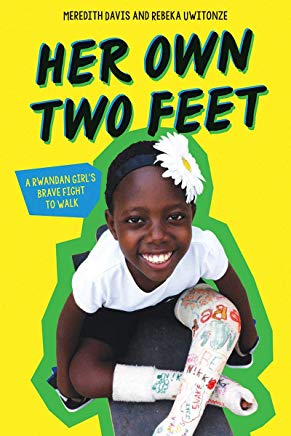
The subtitle of this book really tells most of the story of the book. It is an inspiring story of a brave little girl who at nine, with the help of her sponsors, came half way around the world by herself in order to have the chance to walk on her own two feet. Rebekah had been born with twisted arms and legs and her parents were urged by others in her home in Rwanda to abandon her by the side of the road and let her die. But her parents refused to do that. Instead, they encouraged her to do everything that she possibly could do and then go beyond that.
Doctors in Rwanda tried to straighten her legs once when she was about four, but it didn’t work. Rebekah could not walk to school, so her younger sister taught her everything she was learning each evening when she came home. Rebekah taught herself to walk, instead of crawling around on the ground. However, she had to walk on the tops of her feet since her feet were twisted all the way to the back. Nevertheless, she persisted, and although she never could get her arms to work correctly, she learned how to eat and brush her teeth. One day she found out that a person from America had sponsored her, providing her family with a guarantee of food and a chance for her to go to school. This is itself encouraged her to keep up working toward her goal of walking and going to school.
She did not know that her sponsor was a doctor in America. One day another family who had sponsored children from her village came to visit them. Mr. Clay Davis saw her need and realized that he knew her sponsor and that her sponsor, Dr. Rice, might be able to find another doctor who could help Rebekah walk. Thus began the saga of Rebekah’s struggle to be able to walk. Her father and mother knew that she had lived for a reason, and so they were able to let their little girl go to a strange land with people they did not know to find the help they could not give.
The author of the book is Mrs. Clay Davis. Meredith and Clay Davis not only helped Rebekah come to the U.S. They provided a home for her and treated her as their own daughter through the years that she had to undergo treatments and surgeries. She tells Rebekah’s story from her firsthand knowledge and uses Rebekah’s words to explain all of Rebekah’s emotional turmoil.
I think this book deserves a place in every library. It is a testimony to the power of faith and perseverance. While the people involved in the story are obviously Christian, the story is not overtly about their faith. It shines through, though, because faith is like that. When it exists, people notice, even if editors may have pruned out overt religious references. Buy this for your upper elementary and middle school children – even if it is only for the cultural references which abound in the book.



 truebooktalks