Friday Never Leaving by Vikki Wakefield

Tags

All of her life Friday Brown has been told by her mother that all the women in her family had died from drowning on Saturday. Her mother had named her Friday and raised her on the road – mostly in the outback to try to offset that curse.  When her mother knows she is dying of cancer, she takes Friday back to her father’s house. Friday’s mother dies by drowning in the fluid built up in her body – on a Saturday.  Friday tries, but can’t stay put, and leaves her grandfather’s home. After her mother’s death she finds out who her father was and goes to the city to find him.  Locating him was not very hard, but she can’t bring herself to tell him who she is, neither does she want to return to her grandfather’s home.

After she sees a strange young boy save a child from being hit by a train (an event in which she was credited with saving the child), she tries to find him. She runs into Arden, a cross between Fagan and Jim Jones. Arden is the leader of a gang, of which the boy, Whisper, is a part. Arden rules the group with a heavy hand and will not tolerate any type of disobedience to her wishes.  Friday doesn’t always agree with Arden, and this puts Arden’s control in jeopardy. Arden burns down the house where the gang is living and takes them to the out-back to an abandoned town to live.  Some never return.

This fast-paced story is set in Australia, but the language will not be intimidating for American readers. It will hold one’s interest right to the very end. There are some language and behavior issues, but they only serve to move the story along. I recommend it for the high school library. This was published by Simon and Schuster.
The Hero’s Guide to Storming the Castle

Tags

,

Take everything you have ever thought you knew about fairy tales and their prince and princesses and chuck it out the window.  This sequel to The Hero’s Guide to Saving Your Kingdom gives all the fairy tale prince and princesses different personalities and abilities.  The princes have to band together to fight an evil power that wants to run the world.  The princesses have to help them, because, in spite of the idea that men are the best in battle, it runs out that they really can’t do anything without the women.

I found the story irritatingly inane – just the thing to appeal to elementary boys. I did get a good laugh out of the titles of the chapters: A Hero Makes It Up as He Goes Along, A Hero Has No Sense of Direction, and A Hero Knows How to Count, to name a few.

The person who wants to rule the world is a sloppy, immature, obnoxious eleven-year-old boy named Deeb Rauber. This unlikely villain is a ruler of a group of bandits and miscreants, who for some reason, give Deeb everything he wants. Evidentally Deeb had appeared in the first book, but I figured out who he was very quickly.

Deeb has an object, a piece of orange jade, that can give its holder incredible power, but he is not even aware that he has it.  The princes and princesses , of course, know what it can do  – so they set out to get it away from Deeb.  Of course, they sort of win and sort of lose, thus setting the stage for yet another book in the series.

I think it might have been a good idea to have the author edit the pictures.  For example, there is a sword fight in which Ella (that’s Cinderella for most readers) slides across a polished marble floor on her knees.  Then she gets up and says, “Thank the pants.” However, the picture opposite the scene is very clearly of a girl in a skirt.  In the same scene, she jumps up and grabs a chandelier, but the picture shows a hanging tapestry – not a chandelier.

If you have the first book, and it is circulating, I would suggest that you buy this one.  If this would be your first book in the series, you need to get ready to buy the first one also.


Courage Has No Color; The True Story of the Triple Nickles

Tags

,

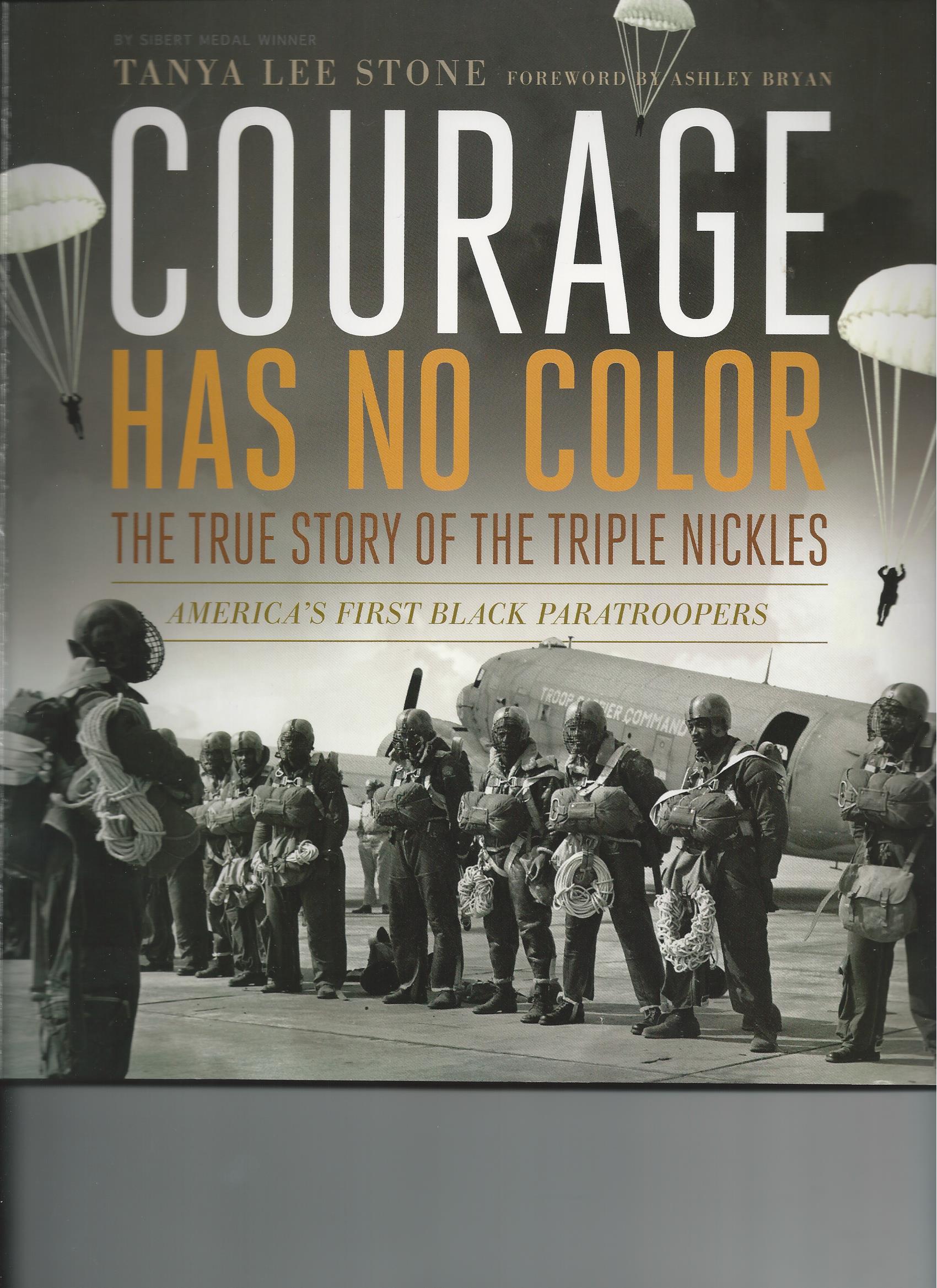
Scan0025  Tanya Lee Stone has done a fantastic job writing the history of America’s first black paratroopers.  Many of us have already learned about the Tuskegee Airmen, but I dare say that few even knew that the 555th airborne division existed during World War II.

Stone starts with a discussion of the racial discrimination that was prevalent in the military at the time.  She takes the reader through the steps toward getting the all black paratroopers ready to jump. Although they never served overseas during the war, they did provide necessary service to the country here at home in the battle with forest fires.

As it turns out, military service was actually needed in the area where the forest fires were occurring.  While none of the fires that the 555th actually worked with were clearly of enemy origin, what the American public did not know was that the Japanese had actually launched balloon bombs to the U.S. One of those bombs killed a woman and five teenagers in Blye, Oregon in 1945.

The government managed to keep the news that a Japanese bomb had made it to the U.S.  out of the news, but they sent the 555th to the Northwest in case others made it to shore and were exploded. This was one of the best kept secrets of the war.  The U.S. did not want Japan to know that they had succeed.  When no news of any bomb attacks made it to Japan, they assumed that the mission was a failure, and they gave up on it.  Imagine what would have happened had they known that they really had succeeded!

The story  of the 555th continues clear up until the actual integration of the military in 1953. It is fascinating, and very easy to read. The book is well researched, fully documented and excellently illustrated with photos, drawings and maps. It is written for middle school to high school students, but I think any history buff will thoroughly enjoy reading it.

I really don’t know how much more I can say about it. The only problem I had with it was that it felt unwieldy to me.  I wanted to read the story in its entirety, which I did.  But, in doing so I had to hold the book in both hands while reading.  It is too wide and heavy to be held in one hand, even if one switches hands in the process.

For those of you who are interested, this has an A.R.of 8  With 5 pts.

The Digital Invasion by Dr. Sylvia Hart Frejd

Tags

, , , , , , ,

I heard about this book yesterday on the radio.  It really intrigued me.  The author tells how the brains of children are being changed by over stimulation with electronic devices of all sorts.  She gives ways parents can tell if the changes are occurring in their child’s brain (or in their brains).  I am going to have to get this to read it in its entirety. It is published by Baker.

If any of you have read it, please leave me a comment. It would be greatly appreciated.

The Maps — Series by Jennifer Besel

Tags

, ,

Titles in this series: All book have a word count of about 150 words. All are supposed to be for Grade One.

What is a Map?

Map Scales.

Types of Maps.

Compass Roses and Directions.

Symbols and Keys.

These books are designed to help develop critical thinking as required by the Common Core. They all contain excellent, colorful pictures and drawings. There is a glossary in each book, but the glossaries do not contain a pronunciation guide. Five new words or phrases pertaining to maps are introduced in each book. Each has a bibliography for further reading and two internet sites students can go to for games and more information. One site is a search site developed for children, and the other is a catalog of other Capstone books.  The students using the Capstone site are able to go to educational games on http://www.facthound.com.  Each book is library bound making it a good choice for school and public libraries.

While these books are written on a first grade level, I definitely have questions concerning the use of three and four syllable words in them. I do not believe that most first graders will be able to read them. They might best be used as a read-aloud to students, and then the teacher can further explain the concepts.

Also, each book contains only 24 pages; therefore, it does not fit the standard for picture books, and also makes the books rather expensive for libraries with limited budgets. Still, the material is clear, concise, and very well presented.  It definitely has a place in elementary libraries and public libraries.  I feel I can recommend it for elementary student probably those in second or third grade, though.

Come August, Come Freedom: the Bellows, the Gallows, and the Black Slave, Gabriel

Tags

, , , ,

      Once in a while, I run across a book that is so well-written and so riveting that I cannot put it down.  I stayed up until nearly two in the morning to finish this book.  Even though I knew the outcome of Gabriel’s uprising

     I recognize that this is historical fiction, but the events are thoroughly researched, and the author has included facsimiles of historical documents within the text. It, of course, is the story of the first well-organized slave rebellion in the US.

     The slaves, led by a blacksmith named Gabriel, modeled their revolt on the American revolution and the revolution in Haiti.  They were trying to get their freedom and an equal voice. Even though they did not succeed, they did get the attention of many people in the US and thus the ultimate freedom of the slaves in America.

      I don’t often highly recommend books, but I honestly believe that this one should be required reading for all students of American history.  I  highly recommend it for the middle school and the high school library.

Angel Fever by L.A. Weatherly

Tags

, , ,

???????????

Did you ever read a series that just begs to be made into a movie?  Such are the books, Angel Burn, Angel Fever, and this, L.A. Weatherly’s latest title, Angel Fever.  Weatherly’s expertise at creating a vivid mental image in the mind of the reader makes a compelling argument for creating the actual visual image.  She practically has the scenes designed for the director.

This one tells the final story of Willow and the AK’s  fight against the vampire-like beings, the angels.  After the destruction of Mexico City, Willow and Alex now try to find the rest of the surviving angels.   Willow’s father, Raziel, one of the angels, is now in charge and has set up camps for the humans who survived the devastating earthquakes.  These “camps” are really farms to insure the surviving angels with constant food sources.

Willow learns that she must open a gateway between the two worlds to send the angels back to their home, and then close it again so they can never return to earth.  In order to do that she must destroy her father.  The author said that she had intended to write about passion, but it ”turned out to be … about forgiveness.”

I thoroughly enjoyed the series, and I expect that it may become popular with teen readers.  Given the mature themes in the books, I think it is best suited for the high school or college/age reader. Weatherley has a good amount of sexual innuendo in the story.  Although the sex is not graphic, some may not want younger readers exposed to it.

The Shadowhand Covenant

Tags

, , ,

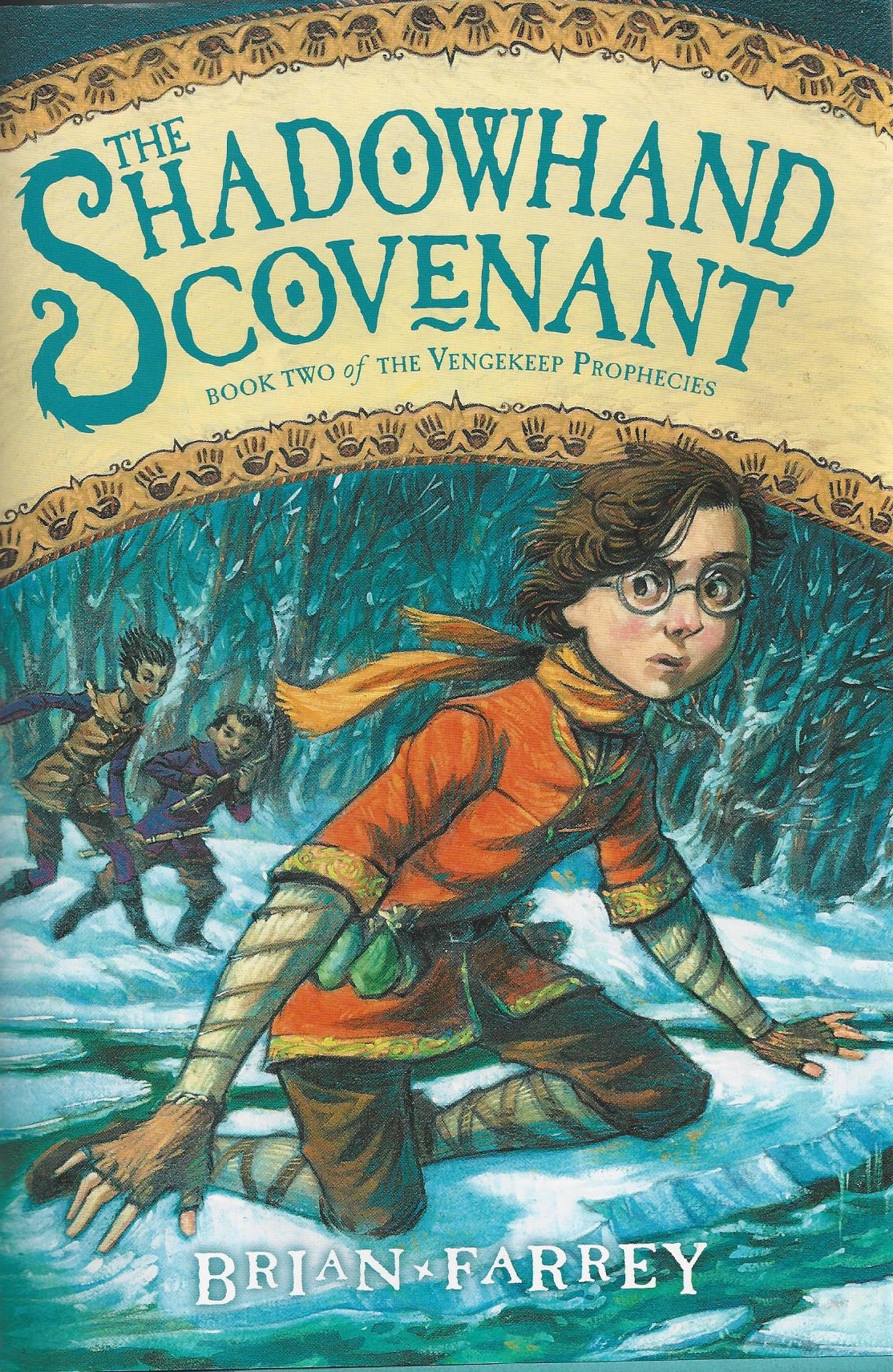
??????????     If you have The Vengekeep Prophecies by Brian Farrey, you most definitely will want to add this to your fantasy collection. This is the second book of the series, but it could be read as a stand-alone.  In this tale, Jaxter Grimjinx, of the infamous Grimjinx family of thieves, must find out why a notorious group of thieves, known as Shadowhands are disappearing.  He also wants to know why the High Laird has begun imprisoning a peaceful group of people known as the Sarosans. Of course, nothing is ever easy, not what it seems to be in Vengekeep.

In the course of his adventure he makes new friends and allies – one of them was a former enemy of his.  At the end of the book, although things are somewhat resolved, the reader will know that more of the story is yet to come. This is a delightful, suspense-filled fantasy for the 10 -12 year old reader.

Any story about children who manage to best adults with their skills or powers is always fascinating to younger readers.  One must suspend concrete knowledge in order the get into the story.  For instance, Jaxter carries with him a few pouches of herbs.  He never runs out of them, although he is constantly using them; and, he always seems to have just what he needs in those pouches.  Once, they are taken away from him, but the stupid adults who took the pouches leave them where he can get his hands on them again. Still, it is a good story, and I feel I can recommend it for upper elementary and possibly the middle-school student.